You’re checking understanding of a new idea using ABCD cards. As pupils decide on their answer, you notice some are watching which card their neighbour chooses before committing themselves. When cards go up, responses are mixed, and it’s hard to judge how secure understanding really is. There are ten minutes left in the lesson.
The impact comes from what happens next.
This new Check. Adapt. resource helps organise these next steps into three pathways teachers may use. The headings reflect patterns teachers see every day, where evidence from pupils guides decisions in the moment:
- Many misunderstand, so pause and fix.
- Some are unsure, so adapt support.
- Most understand, so extend and support.
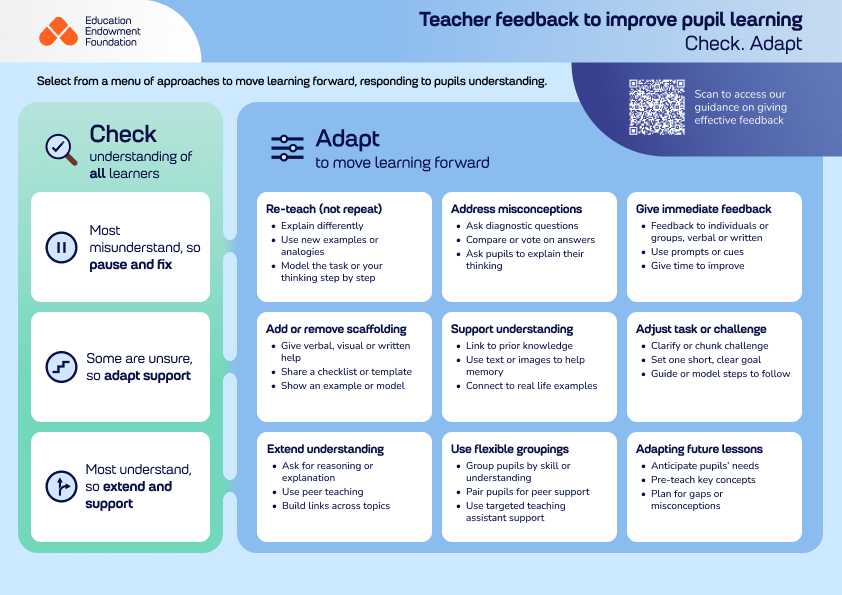
Although the resource is set out in three pathways, the suggested approaches aren’t fixed to one route. Classrooms are rarely that simple. Many approaches can be useful across different situations, depending on what pupils show you. The pathways provide structure; the decisions come from your knowledge of the pupils. Each approach draws on principles found across EEF guidance reports, bringing together ideas teachers may find helpful when deciding how best to support learning.
The resource brings these approaches together in one place so teachers can easily explore options, plan deliberately, and discuss choices with colleagues. You might use it to:
- Plan purposeful responses to common misconceptions.
- Decide how to adjust teaching within lessons.
- Think through when to model, scaffold, prompt or extend.
- Guide discussions giving teams a shared language.
- Create opportunities for colleagues to explore together how they check all learners’ understanding and how they respond to what pupils show.
The second page offers an editable template that can be used to support planning and professional development conversations.
The resource supports professional judgement. It offers possibilities, not a formula or tick box, so teachers can choose how best to act on what pupils show. In busy classrooms with curriculum pressures, it’s not always easy to pause and adjust, but those small, well-timed moves can make a bigger difference to pupils over time.
Check. Adapt. | Practitioner tool
Showing how evidence from pupils can guide teachers’ next steps in the moment.Teacher feedback to improve learning | Editable toolUploaded: • 6.6 MB - pdf
Blogs
Feedback: The engine room of adaptive teaching


Blogs
Adaptive teaching in practice: using feedback to check understanding

Blogs
How checking for understanding can guide your teaching in the moment