
Ensuring every pupil, particularly those from socio-economically disadvantaged backgrounds, can access the curriculum with confidence is an enduring priority for schools, and it’s why focusing on reading fluency matters for all phases of schooling.4
Reading fluency – the ability to read with accuracy, automaticity, and expression (prosody) – is the crucial bridge from word recognition to language comprehension. If pupils are slow or effortful readers, their cognitive energy is tied up in decoding and they struggle to grasp meaning, infer themes, and engage with increasingly complex texts across subjects.
Fast-forward your fluency practice with the help of these EEF resources:
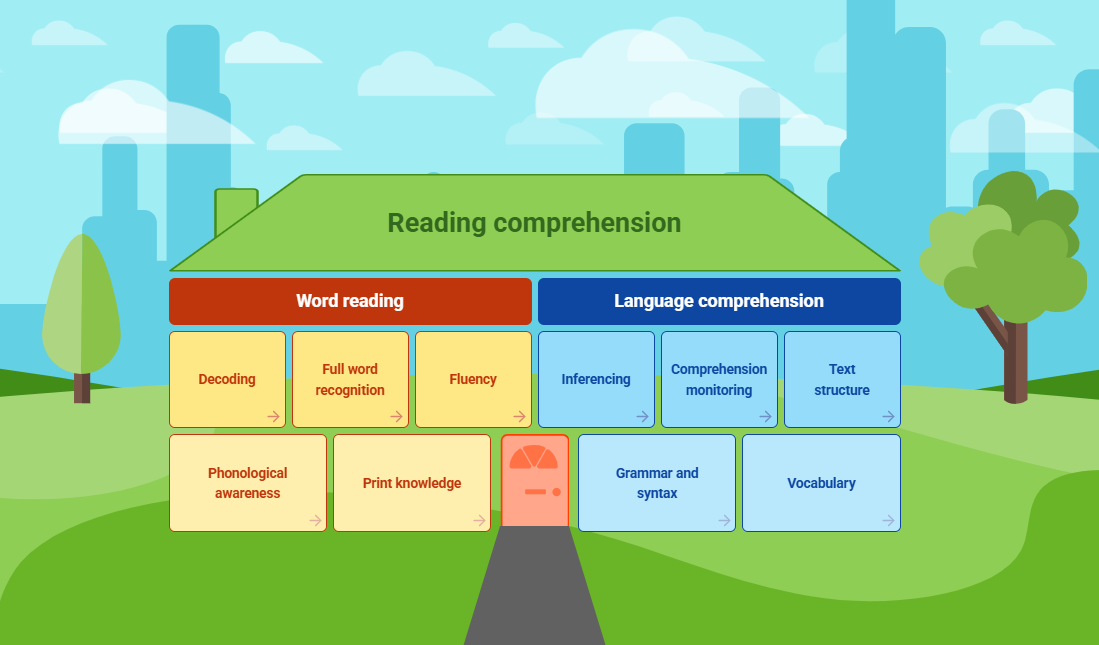
1. The reading house
This interactive online resource breaks down the complexity of reading into key building-blocks and shows us how word reading and language comprehension come together to enable reading comprehension.
As an integral part of the reading house, the fluency room can be used in a diagnostic capacity, and as a tool in professional development, for example:
- Teachers can focus on fluency to strengthen other areas of the house, e.g. prosody supports pupils make sense of syntax.
- The reading house provides a visual model for the component parts of reading and clear definitions to create a shared language for staff training on fluency.
2. Reading fluency tools and resources
- If you’re looking for clear definitions and terminology to share with staff, clarify understanding using our reading fluency glossary to develop a shared language for reading fluency.
Reflect: How consistently is reading fluency defined and understood across your school?
- If you’re keen to dispel the myth that fluency is how quickly a pupil can read a text, debunk this misconception (and others!) using our reading fluency misconceptions resource.
Reflect: Which fluency misconceptions might be influencing your approaches to teaching reading fluency?
- If you’re searching for ways to be more intentional with fluency practice in your school, try Readers’ Theatre (a strategy to support guided oral reading instruction and repeated reading of texts to develop reading fluency)
Reflect: What opportunities do pupils currently have for repeated reading, and how does text choice support this?
3. ‘Go to’ guidance
Our ‘Improving Literacy’ guidance reports for key stage one and key stage two feature key recommendations linked to reading fluency.
From the earliest opportunity, the guidance highlights the importance of:
- Repeated reading aloud from picture books (ensuring pupils can see the text)
- Encouraging pupils to read along with good prosody (where words and phrases are accessible)
- Singing songs together and providing the text for pupils to follow, rehearse, and perform.
Pupils can practise reading fluency through guided oral reading instruction and repeated reading. Reading accuracy and automaticity can also be supported by building pupils’ knowledge of aspects of word structure, such as common letter combinations (orthographic awareness) and the meaningful parts within words (morphological awareness).
Fluency can also scaffold access to more complex academic texts across subjects, through a gradual release of responsibility – from teacher modelling, to choral reading, paired reading, and independent reading – helping older pupils transition to the comprehension demands of the secondary curriculum with discipline-specific vocabulary and texts.
With a shared understanding and evidence-informed tools, schools can take next steps in developing confident practice and fluent readers.