Metacognitive talk sits within subject teaching. It shows up in everyday moments: when a teacher pauses to explain why they are choosing one strategy over another; when pupils talk through how they are tackling a task; or when learning pauses so pupils can check whether what they are doing is working.
Recommendation 4 of the EEF’s Metacognition and Self-regulated Learning guidance states: promote and develop metacognitive talk in the classroom. There is strong evidence that structured talk about learning helps pupils plan, monitor, and evaluate their work, particularly when this talk is deliberately modelled and scaffolded by teachers (EEF, 2025). This can be especially important for pupils experiencing socio-economic disadvantage, who may have had fewer opportunities to engage in this kind of talk.
What could metacognitive talk look like in practice?
Teacher – pupil talk
Teachers often model metacognitive talk by thinking aloud: “I’ve seen a task like this before, so I’m going to start by breaking it into smaller steps. I’ll check as I go to see if that’s helping.” During guided practice, pupils are then prompted to describe how they are approaching a task, using questions such as, “How did you decide where to start?” or “What will you do if you get stuck?”
Peer talk
Peer talk is most effective when it is carefully structured. Pupils may work in pairs using prompts such as “Why did you choose that method?” or “What do we already know that can help us?” These discussions encourage pupils to justify choices and compare approaches before deciding how best to move forward.
Self-talk
Over time, this external talk becomes internalised. Teachers support this by providing scaffolds aligned to the metacognitive process, helping pupils independently review what worked and what didn’t. For example, pupils might reflect: “What helped me succeed here?” “What would I do differently next time?” These prompts help pupils to evaluate their actions and apply their learning in future tasks.

Using the practitioner tool
The Promoting metacognitive talk practitioner tool brings this evidence together in a practical way. It offers question prompts structured around knowledge of the task, strategies, and self, helping teachers model and guide purposeful talk that supports independent, reflective learners.
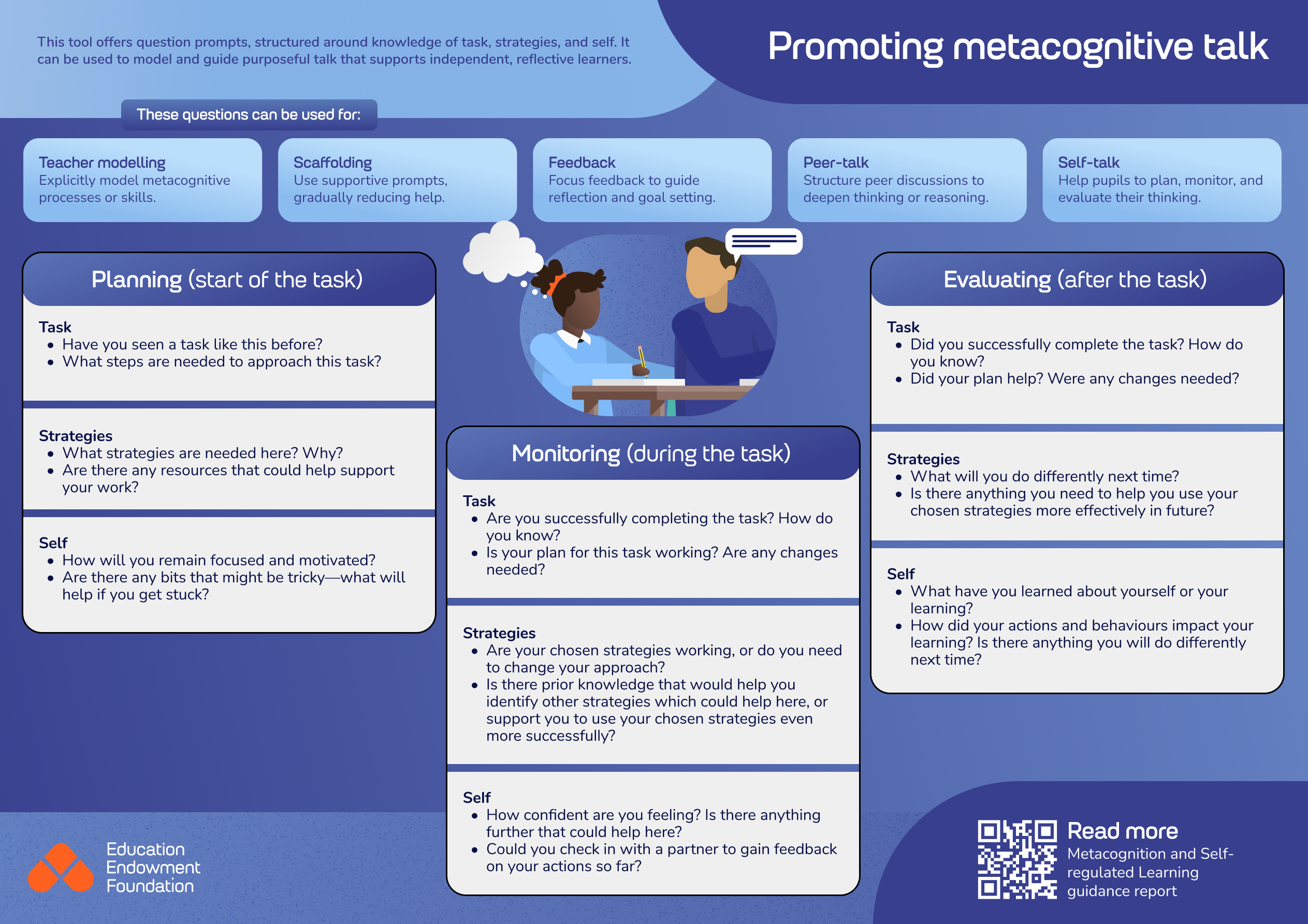
A useful starting point is to:
- Notice where talk already happens in lessons.
- Choose one focus for that moment (planning, monitoring, or evaluating).
- Use the editable template on page two to shape a few prompt questions to model or guide talk.
References
Education Endowment Foundation (2025) Metacognition and Self-regulation guidance report. London: Education Endowment Foundation. Available at: https://educationendowmentfoundation.org.uk/education-evidence/guidance-reports/metacognition.
Education Endowment Foundation (2025) Metacognition and Self-regulated Learning – Evidence to Decision Framework. Available at: https://d2tic4wvo1iusb.cloudfront.net/production/eef-guidance-reports/metacognition/metacognition-and-self-regulation_evidence-to-decision-framework_v.2.2.0.pdf.

Blogs
From Research to Classroom Practice: The updated EEF guide to metacognition and self-regulation.


Blogs
How to use visual, verbal, and written scaffolding to support pupils’ use of metacognitive strategies
